

Are big fire extinguishers shock - resistant?
When it comes to fire safety, big fire extinguishers play a crucial role in combating large - scale fires. As a supplier of Big Fire Extinguisher, we often get asked the question: Are big fire extinguishers shock - resistant? In this blog post, we will explore this topic in detail, looking at the construction, materials, and testing of big fire extinguishers to understand their shock - resistance capabilities.
Construction and Materials
Big fire extinguishers are typically constructed with durability in mind. They are designed to withstand various environmental conditions and potential physical impacts. The outer shell of most big fire extinguishers is made of high - strength steel or aluminum.
Steel is a popular choice due to its excellent strength - to - weight ratio. It can provide a robust protective layer for the internal components of the fire extinguisher. The steel used is often treated to prevent corrosion, which can weaken the structure over time. Aluminum, on the other hand, is lighter and also offers good resistance to corrosion. It is commonly used in applications where weight is a concern, such as in portable big fire extinguishers.
Inside the extinguisher, the container that holds the extinguishing agent, whether it's water, foam, or dry chemicals, is also built to be sturdy. The valves and nozzles are made of high - quality metals or plastics that can endure pressure changes and mechanical stress.
Shock Resistance Testing
To ensure the shock - resistance of big fire extinguishers, manufacturers conduct a series of rigorous tests. One of the most important tests is the drop test. In this test, the fire extinguisher is dropped from a certain height onto a hard surface to simulate a accidental fall. The height and the surface conditions vary depending on the type and size of the extinguisher and the relevant safety standards.
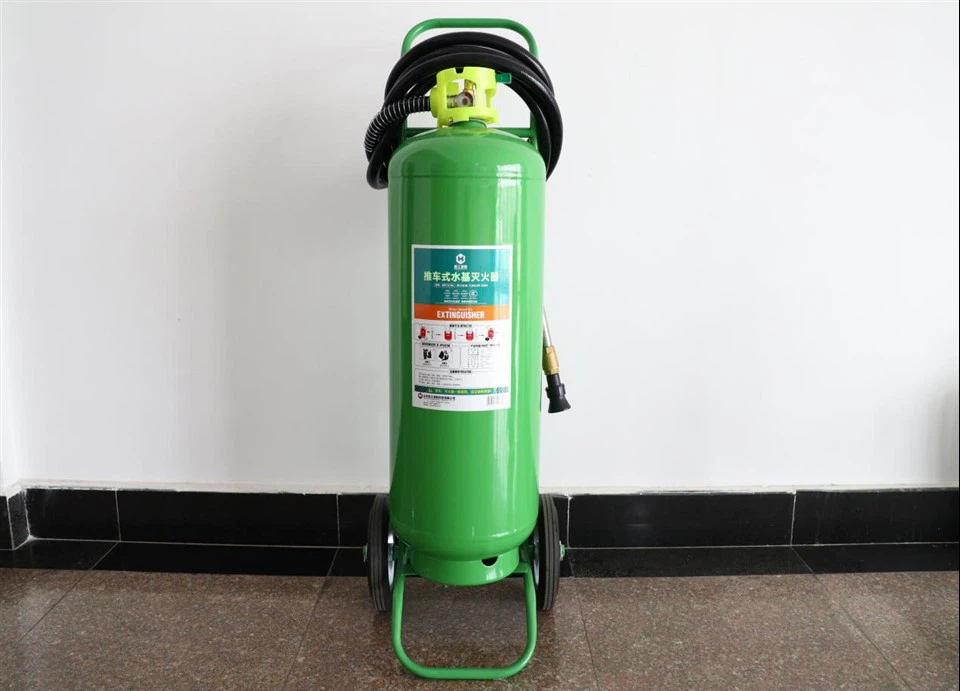

For example, 25kg Water - based Fire Extinguisher may be subjected to a drop test from a height of about 1 - 2 meters onto a concrete surface. After the drop, the extinguisher is inspected for any visible damage, such as cracks in the shell, leaks, or malfunction of the valves. If the extinguisher passes these inspections, it can be considered shock - resistant to a certain degree.
Another important test is the vibration test. Big fire extinguishers may be transported over rough roads or subjected to vibrations during movement. In the vibration test, the extinguisher is placed on a vibrating platform and exposed to different frequencies and amplitudes of vibration. This test helps to ensure that the internal components of the extinguisher remain intact and functional under vibration conditions.
Factors Affecting Shock Resistance
Several factors can affect the shock resistance of big fire extinguishers. The first factor is the size and weight of the extinguisher. Generally, larger and heavier fire extinguishers are more likely to be damaged when dropped or subjected to shocks because they have more mass and momentum. For instance, a 45kg Water - based Fire Extinguisher will experience a greater impact force when dropped compared to a smaller one.
The type of extinguishing agent also plays a role. Some extinguishing agents, such as water, can cause additional pressure inside the extinguisher when it is suddenly shaken or dropped. This can increase the risk of damage to the internal structure of the extinguisher.
The age and condition of the fire extinguisher are also important factors. Over time, the materials of the extinguisher may degrade due to wear and tear, corrosion, or exposure to extreme temperatures. An older fire extinguisher may be less shock - resistant than a new one.
Real - World Applications
In real - world scenarios, the shock - resistance of big fire extinguishers is of great importance. For example, in industrial settings, fire extinguishers may be moved around frequently, and there is a higher risk of accidental drops or impacts. In a manufacturing plant, forklifts and other heavy equipment are constantly in motion, and a fire extinguisher may be accidentally knocked over. If the fire extinguisher is not shock - resistant, it may become inoperable when a fire breaks out.
In high - rise buildings, fire extinguishers are often stored in stairwells or other areas where they may be subject to vibrations from elevators or foot traffic. A shock - resistant fire extinguisher ensures that it will remain functional in these environments.
Our Commitment as a Supplier
As a supplier of big fire extinguishers, we are committed to providing our customers with high - quality, shock - resistant products. We work closely with manufacturers who adhere to strict quality control standards and conduct comprehensive testing on all their products. Our team of experts also inspects each fire extinguisher before it is shipped to ensure its integrity and functionality.
We understand that the safety of our customers is paramount. That's why we only offer big fire extinguishers that have passed the necessary shock - resistance tests. Whether you need a 25kg or a 45kg water - based fire extinguisher, you can trust that our products will perform reliably in the face of shocks and vibrations.
Conclusion and Call to Action
In conclusion, big fire extinguishers are generally designed to be shock - resistant, but their actual performance can be affected by various factors. Through proper construction, materials selection, and rigorous testing, we can ensure that these fire extinguishers can withstand the physical stresses they may encounter in real - world applications.
If you are in the market for high - quality, shock - resistant big fire extinguishers, we invite you to contact us for more information. Our team is ready to assist you in choosing the right fire extinguisher for your specific needs. We can provide detailed product specifications, pricing, and delivery options. Don't hesitate to reach out and start a conversation about how we can help you improve your fire safety.
References
- NFPA 10: Standard for Portable Fire Extinguishers
- ISO 7165: Portable fire extinguishers - Performance and construction requirements