

Products
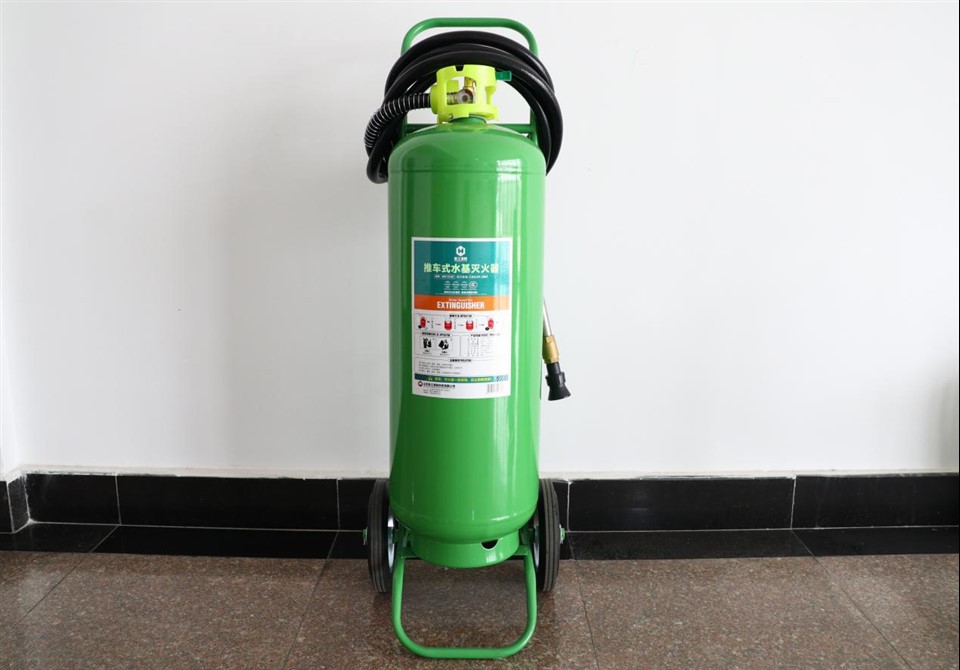
Wheeled Fire Extinguisher
The factor that makes wheeled fire extinguishers so popular is their easy to handle dynamics that make them highly effective. Handling of firefighting system is an important task as there’s a need for a rapid response in case of fire, so it’s ideal to have something like wheeled fire extinguishers to get the job done for you in the minimum period.
Features
What is Wheeled Fire Extinguisher
Wheeled fire extinguishers can be easily operated by one person and are differentiated from"hand portable"fire extinguisher types often simply on the basis of their capacity or total weight. Wheeled units are available in a variety of sizes and extinguishing agents with capacities that range from 30 to 350 pounds. Wheeled fire extinguishers are chosen for the higher capacity (volume), higher flow rates, extended fire fighting range and extended discharge time.
Benefits of Wheeled Fire Extinguisher
Simple handling:The factor that makes wheeled fire extinguishers so popular is their easy to handle dynamics that make them highly effective. Handling of firefighting system is an important task as there's a need for a rapid response in case of fire, so it's ideal to have something like wheeled fire extinguishers to get the job done for you in the minimum period.
Agent capacity:The wheeled fire extinguishers can store a large amount of extinguishing agent capacities, delivering a higher amount of pressure and agent flow rates in cases of emergency. The one thing that makes them unique compared to the rest of the competition is the fact that they can also offer additional firefighting ranges and extend discharge times depending on the needs and the degree of fire that has erupted.
Mobility:Wheeled fire extinguishers are suitable for large areas as they are equipped with wheels, and they can be easily shifted from one spot to another. Mobility is one of the key factors that makes them ideal for large-scale industrial use where there is a requirement for prompt action against any degree of fire.
Coverage:The wheeled fire extinguishers have a longer range and greater coverage area that offers more flexibility when dealing with congested places. The high pressure and excellent throw capabilities are effective against all degrees of fire and can be utilized to reduce the impact of the fire. The ability to offer greater exposure these have been used in various complex situations.


Why Choose Us
Shandong Hanggong Fire Technology Co., LTD. High-end environmental protection fire-fighting equipment production base covers an area of 10,000 square meters, building area of 8,000 square meters.
The project is mainly used for the production of various types of fire extinguishers, water extinguishing agents and other fire-fighting equipment, with an annual output of 9 million sets of water-based fire-fighting equipment of various types and 30,000 .
Rescue type: ABCEF fire in addition to combustible metal fire can be all rescue, and can be insulated 36kv electricity, is the best choice to rescue electrical fire.
Simple water-based fire extinguisher production line
Portable water - based fire extinguisher production line
Fire extinguishing agent production line
Fire extinguishers drive the nitrogen production line
What is the Discharge Range of a Wheeled Fire Extinguisher?
Wheeled extinguisher is designed to tackle Class A, B and C fires, with a discharge duration of 38 seconds over a range of 14 metres.
Are There Different Types of Agents Used in Wheeled Fire Extinguishers?
Wheeled fire extinguishers are generally divided into three types: CO2, dry powder, and foam. Among them, CO2 fire extinguishing agent is suitable for grease, electrical equipment and other occasions, dry powder fire extinguishing agent is suitable for common material fires such as fuel and wood, and foam fire extinguishing agent is suitable for liquid fires and volatile liquids such as paint.
Specifications and Models of Wheeled Fire Extinguishers
CO2 wheeled fire extinguisher
Generally divided into three specifications according to the quality of the fire extinguishing agent: 2kg, 3-4kg, and 6-7kg. The rescue distance will also be different. The more commonly used one is the 3-4kg specification, which can cover Larger area.
Dry powder wheel-type fire extinguishers
Generally divided into various specifications such as 4kg, 6kg, 8kg, 10kg according to the quality of the fire extinguishing agent. Different specifications are suitable for fire situations of different sizes. For example, smaller fire extinguishers are available for vehicle and home use, while larger fire extinguishers are suitable for businesses or public spaces.
Foam wheeled fire extinguisher
Generally divided into two specifications: 6kg and 9kg according to the quality of the fire extinguishing agent. The foam can effectively cover the fire surface and effectively control the flame. It is suitable for liquid and paint fires, but is not suitable for electrical equipment fires.

How To Use Wheeled Fire Extinguishers
Release the hose from the holding and unfold it;
Remove safety pins and open gas cylinder;
Take a firm stance and aim to the base of the fire;
Slowly open the nozzle bail and start spreading the extinguishing agent with a steady side-to-side movement at the base of the fire.
Remember to stay at least 15ft away from the blaze or even further if your type of extinguisher allows it.
Vacuum or sweep up loose debris. Spray stuck-on residue with isopropyl alcohol diluted 50 percent with warm water. Let the solution sit for several minutes, and then wipe with a damp rag. To neutralize sodium bicarbonate and potassium bicarbonate residue, apply a solution of 98 percent hot water and 2 percent vinegar.
How do you Dispose of an Expired or Discharged Wheeled Fire Extinguisher?
Check with Local Regulations: Verify local regulations for the disposal of fire extinguishers, as they may vary by location. Many areas have specific guidelines for the disposal of hazardous materials.
Release Pressure: If the extinguisher is not completely discharged, release the pressure in a safe and controlled manner. Point the nozzle away from yourself and others, and discharge the remaining contents in an open, well-ventilated area.
Recycling Centers: Some recycling centers accept fire extinguishers for disposal. Contact your local recycling facility to inquire if they have the capability to handle expired or discharged fire extinguishers.
Hazardous Waste Disposal: If the extinguisher contains hazardous materials, such as certain types of chemicals or gases, follow your local hazardous waste disposal procedures. Many communities have designated facilities for handling hazardous waste.
Remove Valuables: Before disposal, remove any valuable or recyclable parts of the extinguisher, such as metal components, to minimize environmental impact.
Labeling: Clearly label the extinguisher as"empty"or"discharged"to prevent confusion during the disposal process.
Material of Wheeled Fire Extinguisher
Aluminium – Used exclusively for CO2 extinguishers due to higher pressure. Steel – Used for the majority of water and powder-based extinguishers as well as some CO2 units. Stainless Steel – Used for select extinguisher bodies.
Application of Wheeled Fire Extinguisher
Wheeled fire extinguishers are usually installed on ships, oil rigs, helicopter decks, petrochemical plants, oil refineries, airports, large warehouses and factories. They allow rapid and flexible fire fighting with a substantial amount of extinguishing agent. This gives time in between the fire breaking out and the fire brigade arriving. In isolated locations and ships, wheeled fire extinguishers are the only option to deploy larger amounts of fire fighting chemicals in a self sufficient way.
Components of Wheeled Fire Extinguisher
Pneumatic tires
The pneumatic wheels are designed to be move effective in moving the fire extinguisher unit when the surface that you will traverse is soft or softer than a hard surface. Pneumatic tires are often found on wheeled fire extinguishers that weight less than 400 pounds (181 kg).
Large steel wheels
The large wheels, up to 36" x 6", enhance leverage and mechanical advantage allowing the user, often as single user, to more easily and quickly transport the very heavy load. Most wheeled fire extinguishers that weigh over 400 pounds (181 kg) have steel wheels.
Frame
The frame supports the cylindrical tank and the axel to it so that the wheels will be assembled for heavy duty support and stability.
Cylinder tank
Wheeled fire extinguisher tanks are large and can carry hundreds of pounds of extinguishing agent. They are similar in look to the flat bottom and dome shaped top of hand portable extinguishers, only significantly larger.
Nitrogen cylinder with turn valve
This tank houses the nitrogen or propellent that is used to pressurize and expel the extinguishing agent from the extinguisher tank. The turn valve atop the cylinder opens and closes to release the nitrogen into the extinguisher cylinder tank.
Hose with nozzle assembly
the nozzle has a bale or handle assembly that allows the user to adjust the flow rate of the extinguishing agent and nitrogen propellent by moving it backward to release the agent and pushing it forward to reduce and turn off the flow of agent.
Extinguishing agent
The substance that limits or suppresses the spread of the fire. An understanding of the different classifications (Classes) of fires is helpful in determining which type of fire extinguisher is best for your situation.
The primary difference between hand portable fire extinguishers and wheeled fire extinguishers is the larger capacity of tank and the extinguishing agent it can carry. Hand portable fire extinguishers weigh up to 20 kg, and wheeled fire extinguishers can weigh over 800 pounds. Because of this primary difference of weight, engineers needed to design the fire extinguisher so that it could be transported and maneuvered by a single person. This mandated the need for wheels to be added to a frame which supported the tank so the person could transport it, by themselves, down corridors, around corners, and over rough terrain. In other words, it must allow the person to respond and act to extinguish the fire before it gets out of control and unable to be combatted by a fire extinguisher.
Maintenance Tips for Wheeled Fire Extinguisher
If your fire extinguisher has been sitting under the sink for years, it may likely develop some corrosion or rust build-up. Be sure to check for any signs of damage or leaks in the extinguisher. Even the tiniest leak will render your device useless. It is essential to inspect your fire extinguishers at least once a month to check for any signs of a leak or corrosion.
When a fire extinguisher sits for a long time, the chemicals inside can settle to the bottom. The worst thing that can happen during a fire is finding out that your fire extinguishers are not functioning. Shake around the dry chemicals in the fire extinguishers once a month to prevent the contents from settling and hardening at the bottom of the canister.
Examine the tamper seal and pin on the fire extinguisher and make sure they are still intact. If they are not, the device will have to be replaced. It is essential that you recharge your extinguishers even after a single use. A fully charged device is imperative to proper fire protection for your home or business.
Check to make sure that your fire extinguishers are not blocked by equipment, clothing or other objects. If they are, remove those objects immediately. Fire extinguishers must be easily reachable and accessible to every member of your household. Do not place them on high shelves or in the back of closets where they would be difficult to find in an emergency.
Things to Note When Using Wheeled Fire Extinguisher
Check the fire extinguisher pressure valve before use. Under normal circumstances, the pointer should point in the green area, the red area represents insufficient pressure, and the yellow represents excessive pressure. Wheeled fire extinguishers must be used upright. After the safety pin is removed, the nozzle mouth is prohibited from facing people to prevent injury. When extinguishing fire, the operator must operate in the upwind direction. Pay attention to the effective distance and usage time of the fire extinguishing point.
With a total investment of 300 million yuan, the project is mainly used for the production of various types of fire extinguishers, water extinguishing agents and other fire-fighting equipment, with an annual output of 9 million sets of water-based fire-fighting equipment of various types and 30,000 tons of water extinguishing agents, with an output value of 1.7 billion yuan and a tax revenue of more than 180 million yuan.


Certifications


FAQ
Hot Tags: wheeled fire extinguisher, China wheeled fire extinguisher manufacturers, suppliers, factory, office water based fire extinguisher cart, water based fire extinguisher cart for sale, hotel water based fire extinguisher cart, regulatory compliant water based fire extinguisher on cart, water-based fire extinguisher cart for amateur fire fighters, portable water based fire extinguisher cart
No Information
You Might Also Like


Send Inquiry
